Anthropic filed a confidential S-1 on 1 June. Press reports point to a listing in October, not confirmed by the company. I am a solo contractor who does almost all of his work through Claude Code, on the Max 20x plan, at $200 a month. The question I have been avoiding is simple: how much of that $200 is a price, and how much is a subsidy? And what happens to the subsidy when the company that pays for it has to report margins every quarter?
I did not want to answer with a feeling. I wanted to answer with my own numbers. This is the follow-up to the July audit of 107 sessions, same method, different question.
The method, in three sentences
Every Claude Code session is saved locally as JSONL under ~/.claude/projects/. I ran ccusage over the files from 1 August to 9 September, which gives tokens per model per day and per session, then re-priced the tokens with a small Python script that holds the September 2026 API list prices in a dictionary at the top of the file. Anyone with the same folder can replicate this in an hour, and the script is the kind of thing Claude writes for you in five minutes.
Two rates matter for what follows. My billable rate is $50 an hour. The subscription is $200 a month. Everything else is measured.
The numbers
| 3 August – 9 September 2026 | |
|---|---|
| Calendar days / active days | 38 / 26 |
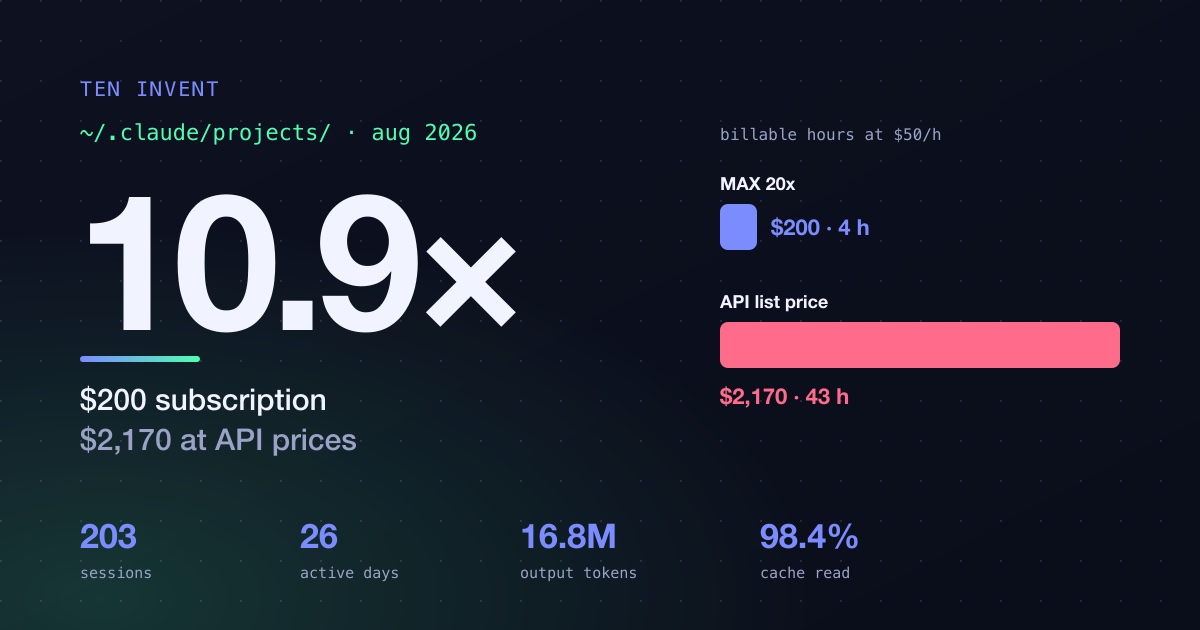
| Sessions | 203 |
| Output tokens | 16.8 million |
| Input tokens, all kinds | 5.0 billion |
| Of which served from prompt cache | 98.4% |
| API-equivalent cost, list prices | $3,203 |
| August alone, API-equivalent | $2,170 |
| Share of Fable in output tokens, August | 64% |
Five billion input tokens sounds absurd until you remember how an agent works: every tool call sends the whole conversation back to the model. That is why 98.4% of the input is cache reads, billed at a fraction of the input price. The fully priced input, the part that is actually new, is 233 thousand tokens. The whole economy of agentic coding rests on that one discount, and I will come back to it.
Here is the same period day by day, priced at API rates, with the monthly subscription drawn as a line.
Four individual days cost more, at API prices, than I pay for the entire month. The most expensive one, 10 August, was $338: 1.1 million output tokens, most of them on Opus 5, in one long agentic session on a client platform. A typical active day is around $120. The quiet week of 17 to 23 August, when I was mostly not working, cost $30 in total.
The other thing the chart shows is that my usage is not a steady stream. It comes in weekly bursts of $700 to $760 (ISO weeks 32, 33 and 36), separated by near-silence. That shape matters more than the average, and it matters for a specific reason I will get to.
The subsidy
In August I consumed $2,170 worth of API calls and paid $200. That is a ratio of 10.9 to 1. On the average of the two full months I have logs for, it is 8.6 to 1.
Translated into my own currency, billable hours at $50:
| Cost per month | Billable hours | |
|---|---|---|
| Max 20x subscription | $200 | 4.0 h |
| Same usage, API list prices, August | $2,170 | 43.4 h |
| Same usage, API list prices, two-month average | $1,715 | 34.3 h |
I am not paying for a $200 tool. I am receiving roughly $2,000 a month of compute for $200, and the difference is absorbed by a company that is about to have shareholders.
There is a detail here that I find more interesting than the headline. My "API-equivalent cost" is not one number. It is three, and all three are correct:
| How you price the same tokens | Cost, 38 days |
|---|---|
| List prices, cache writes at the 5-minute rate | $3,203 |
| List prices, cache writes at the 1-hour rate Claude Code actually uses | $3,657 |
What ccusage reports out of the box |
$5,308 |
The first number uses the prices from the pricing page. The second corrects one thing: Claude Code writes 80 to 98% of its cache with a one-hour TTL, which Anthropic bills at twice the input price, not the 1.25× quoted for the five-minute TTL. I only found that by reading the JSONL, where every request records the split. The third number is what the most popular usage tool prints, because its price table still carries $1.00 per million cache-read tokens for Fable 5, the rate before Fable 5.1 cut it to $0.25.
So even the "true" API cost of my month moves by 65% depending on which cache rate you believe. Nothing in that spread is a price increase anyone announced. That is the point: with 98.4% of input served from cache, my bill is a function of the cache discount, not of the list price. Fable 5.1 moved cache reads from $1.00 to $0.25 per million and nobody called it a price cut. The reverse move would triple my API-equivalent cost and nobody would have to call it a price increase either.
The fear, priced
The instinct after an IPO announcement is to worry about the sticker. So let me price the sticker first, and then the things that actually scare me.
Scenario 1: Max doubles to $400. Eight billable hours a month instead of four. Compared with what the tool produces, this is noise. Triple it and it is still noise. I would grumble on LinkedIn and pay.
Scenario 2: Max stays at $200 and the limits shrink. This is the one that has already started. Fable has been capped at 50% of the weekly allowance on Max since it arrived on the plan, and past the cap you pay as you go, at API rates. In August, Fable was 64% of my output tokens. In September so far, with Fable 5.1, it is 86%. I am already above the cap in shape, if not yet in the exact accounting, and the accounting is not published. Add the burst pattern from the first chart: a weekly limit does not hit my average, it hits my delivery weeks, the ones at $750. If the pool were halved and the overflow billed at API rates, my month would be roughly $200 plus $1,085, about 26 billable hours. The assumption is crude, but the direction is not.
Scenario 3: the subscription stops making sense for my usage and I move to the API. $1,700 to $2,200 a month. 34 to 43 hours. A quarter of a billable month, every month, for the same work I do today. This is the actual worst case, and it is not a doubling. It is a tenfold increase that requires no press release, only a quiet tightening of what "included usage" means.
The honest summary: the list price of the subscription is not the risk. The risk is the distance between $200 and $2,170. Today Anthropic covers that distance, presumably because it buys them developers, data and a story for the S-1. A CFO with quarterly reporting sees the same distance as a cost line with my name on it.
For balance, because this should not read as FUD: the trend so far has gone the other way. Opus went from $15/$75 to $5/$25 per million. Fable 5.1 cut cache reads fourfold. Weekly Claude Code limits get a permanent 25% raise from 14 September. The IPO story is built on enterprise revenue, not on $200 subscribers. All of that is true, and none of it is a contract.
What I do with this
Not much, and that is deliberate.
I am not leaving Claude pre-emptively, and I am not rebuilding my workflow on a weaker model out of a sense of independence. Depending on a good supplier is normal. Every trade depends on its tools, and every tradesman's hourly rate already includes them. My rate includes this one.
What I am doing is keeping three numbers current, recomputed every month with the same script:
- What it costs me now. $200, four billable hours.
- What it costs if the included usage halves. About $1,300, 26 hours, under the assumption above.
- What it costs if I have to pay API prices for all of it. $1,700 to $2,200, 34 to 43 hours.
Depending on a supplier is fine. Depending on a supplier without knowing your exit price is not. The three numbers are the exit price. As long as I know them, the S-1 is a news item, not a threat.
The three questions
If you run a business that leans on an AI subscription, you can answer the same three questions in an afternoon, with your own logs:
- How much does it cost you today, in your billable hours?
- What happens tomorrow if the included usage is cut in half?
- What would the same work cost at API prices?
If you know those three numbers, the fear turns into a decision. If you do not, it stays a fear, and fear is a bad way to run a company. The script, the numbers and the method are all in this article; the folder is on your disk already.
Usual disclaimer: I think this technology is the future of our trade and I expect the pricing to keep moving in both directions. The figures above come from my own Claude Code logs for 3 August to 9 September 2026, priced at Anthropic's published API rates for September 2026, and they describe one person's usage, not a market. If you want help putting a number on your own dependency, talk to us.