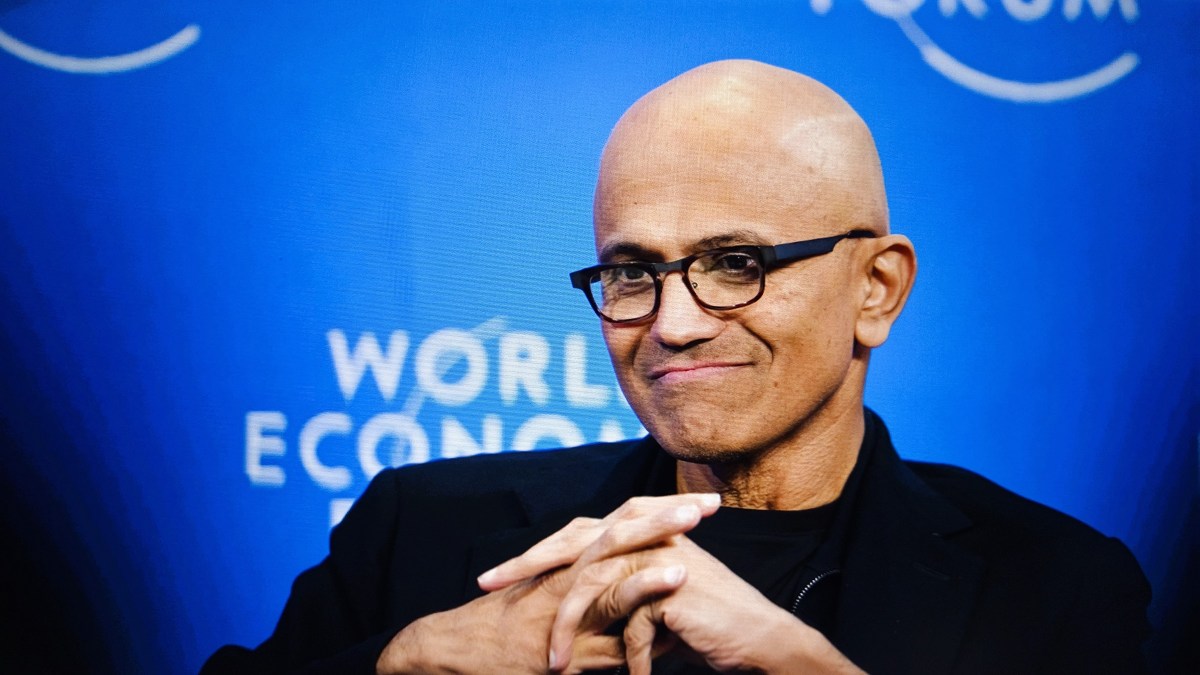
There's a postcard from Futurism making the rounds on social media: a photo of Satya Nadella at Davos, wearing that ambiguous smile, and a headline in heavy type — "Microsoft CEO Warns That Companies Embracing AI Could Drive Themselves Out of Business."
The first reflex, and the correct one, is to ask whether it's real. It is. The quotes are authentic, the source is verifiable, nobody made anything up. I traced the chain all the way back and it ends somewhere solid: an interview Nadella gave on Sunday, July 26, on Fareed Zakaria's CNN show, picked up on Monday by TechCrunch and onward from there.
So no, it's not fake. But between what Nadella said and what's printed on the card there's a distance worth walking on foot, because that distance is exactly where the useful part lives.
What he actually said
Zakaria asked him what it means, concretely, for a company to "share too much" with an AI model provider. Nadella's answer had three layers.
First: watch everything you hand over. Not just proprietary data, but prompts too. A company's prompts are, if you think about it, a pretty good map of how that company thinks — what questions it asks itself, in what order, with what assumptions.
Second: keep the metadata. Nadella called for a setup in which, every time you use the model, everything that happens around the call stays with you — so that at some point you can train your own weights or your own open model. The practical mechanism is called an AI gateway: an intermediate layer that all model calls pass through, which logs, filters, and leaves the history with you.
Third, and the one quoted everywhere: any company that doesn't have this control, he said, won't remain a company — because it has outsourced its thinking.
On top of that came the technical recommendation, the most concrete one in the whole interview: keep the harness separate from the model, and keep context and memory separate from the model. The harness is the software the model is packaged in — Claude Code and Codex are examples. His point is that if you keep these layers separate, you can use multiple models for what each is good at, and, more importantly, any one of them can disappear without leaving you stranded.
What the headline became
Now reread the headline: "companies embracing AI."
Nadella didn't say that. He said "companies that depend exclusively on the proprietary labs, with no control over their own data." That's a subset, and a fairly narrow one. A small business using ChatGPT to write emails is not in the category he was talking about. A company that has moved its entire business logic into agents running on someone else's infrastructure, keeping nothing — that one is.
The transformation happened in two steps, each reasonable on its own. TechCrunch headlined it "companies that trust one AI for everything may not survive" — already louder than the original, but still honest. Futurism stripped out the qualifiers and left just "companies embracing AI." It's not a lie; it's lossy compression, applied twice.
It's also worth saying that Futurism is a publication that lives off headlines like this. It's not disinformation, it's a business model. The difference matters, but it doesn't change your obligation to read the source.
The uncomfortable part: who profits from this warning
Microsoft is an investor in the two big labs, Anthropic and OpenAI. And it's also Microsoft, through Azure, that sells exactly the kind of alternative infrastructure Nadella recommends — gateways, multi-model orchestration, hosting for open-weight models.
TechCrunch calls it what it is: an obviously self-interested fear tactic. And immediately adds, correctly, that this doesn't make him wrong.
Because he isn't wrong. Companies really are discovering that they need more model options, especially cheaper ones, and really are turning to open-weight models they can fine-tune and run on their own hardware. And Nadella's underlying concern isn't runaway budgets; it's something else: once you've outsourced your thinking to a model, there isn't much stopping that lab from eventually launching your service itself. It's the fear the startup ecosystem has had about platforms for years, now moved up to the enterprise level.
A piece of advice can be self-interested and true at the same time. Those are, in fact, the most useful kind — because the person giving it has thought about it seriously.
The detail almost nobody picked up
Here's the part I found most revealing in the whole interview, and it vanished completely from the headlines.
Nadella's warning applies only to companies. When Zakaria explicitly asked how ordinary people can protect themselves, Nadella shrugged: in the consumer space there has to be an exchange of value, you get something for free, you give data, that's how the advertising model has always worked.
So: if you're a company, your data is strategic capital you must defend with architecture. If you're a person, your data is the rent you pay for the service.
I'm not saying it's an indefensible position. I'm saying it is a position, and that it was stated very casually, in a single sentence, by the man running one of the largest software companies in the world. I think it deserved more attention than it got.
What you actually do, if your company has ten people and not ten thousand
Nadella is speaking to the Fortune 500. The honest question is what part of his advice applies to a small consulting shop and what part is simply too much.
Applies — separating context from model. This is the best advice in the whole interview and it's free. If you keep your system prompts, internal documentation, examples, and conventions in a format you own — files, a repo, a local vector database — then switching providers is a configuration matter, not a rewrite. If all your context lives in someone's interface, you have a problem the day the price doubles or the product changes. We built Bob on exactly this premise, multi-provider from day one, and not because we anticipated some catastrophe, but because it's simply easier to maintain.
Applies partially — usage retention. The idea of logging your calls so you can someday train your own model is unrealistic at small scale; you'll never have the volume. But logging has another, immediate benefit: after three months you know exactly what you're spending on, what works, and what doesn't. A simple gateway, even a minimal one, pays for itself with the first invoice you genuinely understand.
Doesn't apply — the panic about harnesses. Nadella wants companies to walk away from the labs' integrated coding tools. For a small team, that would mean giving up the biggest productivity gain of recent years to defend against a risk that materializes, if it materializes at all, over years. Use them. Just don't build your processes so that you can't get out of them.
Applies in full — what you send to the model. Client contracts, client data, proprietary code. That's not architecture paranoia, it's basic hygiene and, in many consulting contracts, a contractual obligation. You don't need Nadella to know this, but it's a good moment to reread what you signed.
Brutal summary: from his advice, a small business should keep "don't tie your processes to a single provider" and ignore "build your own model." The first is discipline, the second is capex.
As every time I write something critical in this space: AI is the future, and the problems above — vendor lock-in, cost opacity, lack of context portability — will get solved. They're being solved already: open standards, open-weight models getting better and better, orchestration tools that didn't exist two years ago. But they get solved for the people who see them now, not for the ones who discover the problem the day their provider changes its prices. That's the only reason it's worth reading the source, not the headline.
Sources: Satya Nadella's interview on CNN's "Fareed Zakaria GPS" (July 26, 2026); Julie Bort, TechCrunch, July 27, 2026; Frank Landymore, Futurism, July 30, 2026.